





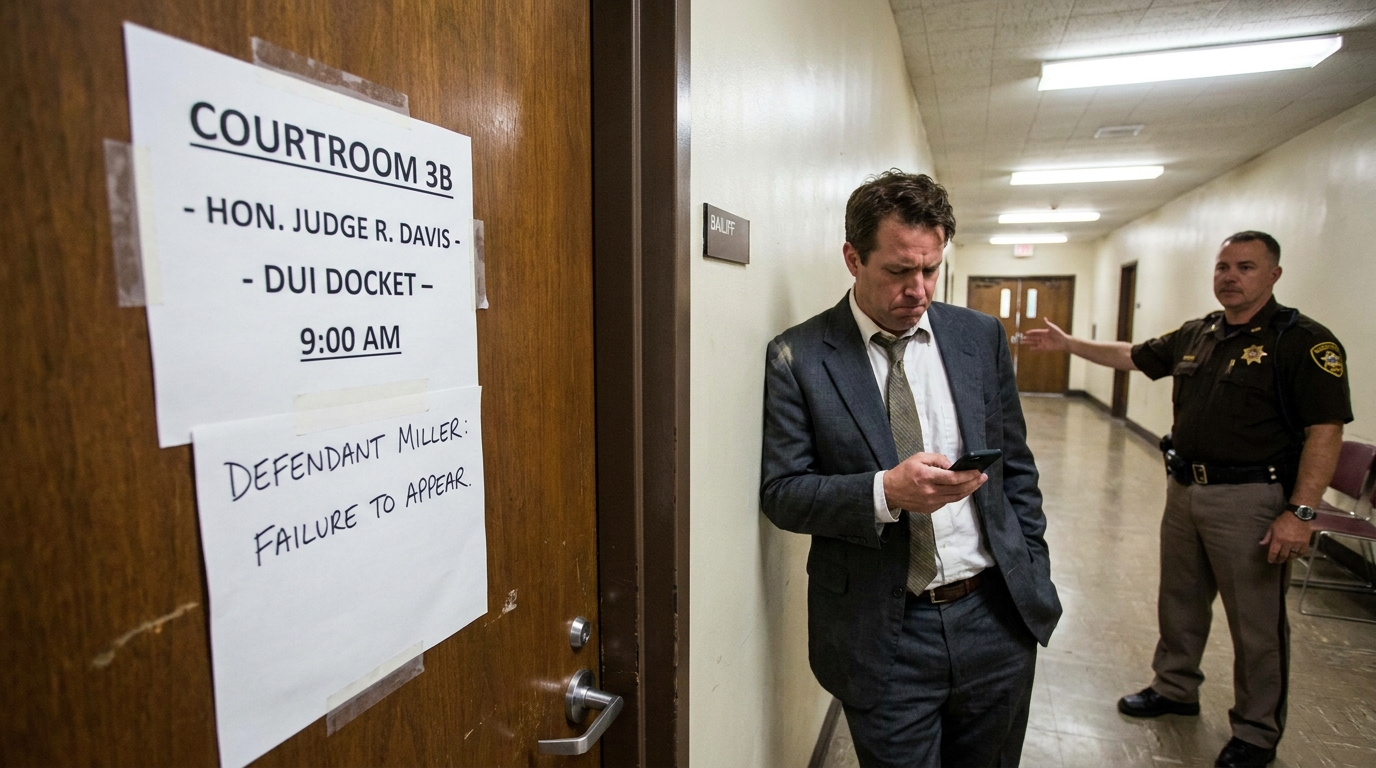
Missing a DUI court date in Arizona can create a problem that needs immediate attention, but a missed DUI court date in Arizona does not automatically mean you have been convicted of DUI or convicted of failure to appear. Depending on the court, the type of hearing, and the underlying criminal charge, a judge may issue a bench warrant, change release conditions, require a bond, or trigger other consequences. In some criminal traffic cases, a missed court appearance can also affect your Arizona driving privilege.
A bench warrant can expose you to arrest during a later encounter with law enforcement. It can also make an already stressful Arizona DUI case more difficult. Arizona courts explain that bench warrants are commonly issued when a defendant fails to appear in court for a required appearance. A warrant generally remains active until the person is arrested or the issuing court takes action to resolve or cancel it.
The good news is that you may be able to address the warrant before an unexpected arrest occurs. In many cases, a criminal defense attorney can determine why the warrant was issued, contact the correct court, file a motion to quash the warrant, request a hearing, and explain the circumstances behind the missed appearance. Attorney Arja Shah can also continue defending the underlying Arizona DUI charge because missing court does not establish that the prosecution can prove the DUI allegations.
- What Happens After a Missed DUI Court Date in Arizona?
- Arizona Failure to Appear Laws Under ARS 13-2506 and ARS 13-2507
- When Does an Arizona Court Issue a Bench Warrant?
- How to Quash a Bench Warrant After Missing DUI Court
- Potential Penalties for Failure to Appear in a DUI Case
- Defense Strategies for Failure to Appear and the Underlying DUI Charge
- Common Reasons People Miss Arizona DUI Court Dates
- FAQs About Missing a DUI Court Date in Arizona
- Important Things to Remember
- How Shah Law Firm Can Help
What Happens After a Missed DUI Court Date in Arizona?
What happens if you miss a court date depends heavily on where the DUI case is pending and which court appearance you missed. Arizona DUI cases can proceed through municipal courts, justice courts, or Superior Court depending on the criminal charge. A misdemeanor DUI under ARS 28-1381 is generally a Class 1 misdemeanor, while many aggravated DUI offenses prosecuted under ARS 28-1383 are felonies.
For a misdemeanor Phoenix DUI, for example, the case might be pending in Phoenix Municipal Court. DUI cases arising elsewhere in Maricopa County might proceed through a municipal court or one of the Maricopa County Justice Courts. A felony aggravated DUI generally proceeds in Superior Court. Scottsdale, Tempe, Mesa, Chandler, and Glendale also have local court systems that may handle misdemeanor criminal cases occurring within their jurisdictions.
If a defendant does not appear for a scheduled court date when personal attendance is required, the judge may issue a bench warrant for the defendant’s arrest. The Arizona Judicial Branch explains that a bench warrant is typically issued after a person fails to appear or fails to follow a court order. Once the warrant has been issued, a police officer can arrest the defendant.
There may also be driving consequences. Under ARS 28-3308, when a court notifies the Arizona Department of Transportation that someone failed to appear for a scheduled appearance after being served with a criminal complaint alleging a Title 28 violation, the person’s driver’s license or nonresident driving privilege must be suspended until the person appears. Because Arizona DUI offenses are contained in Title 28, this law can become especially important after a missed DUI court date.
Arizona Failure to Appear Laws Under ARS 13-2506 and ARS 13-2507
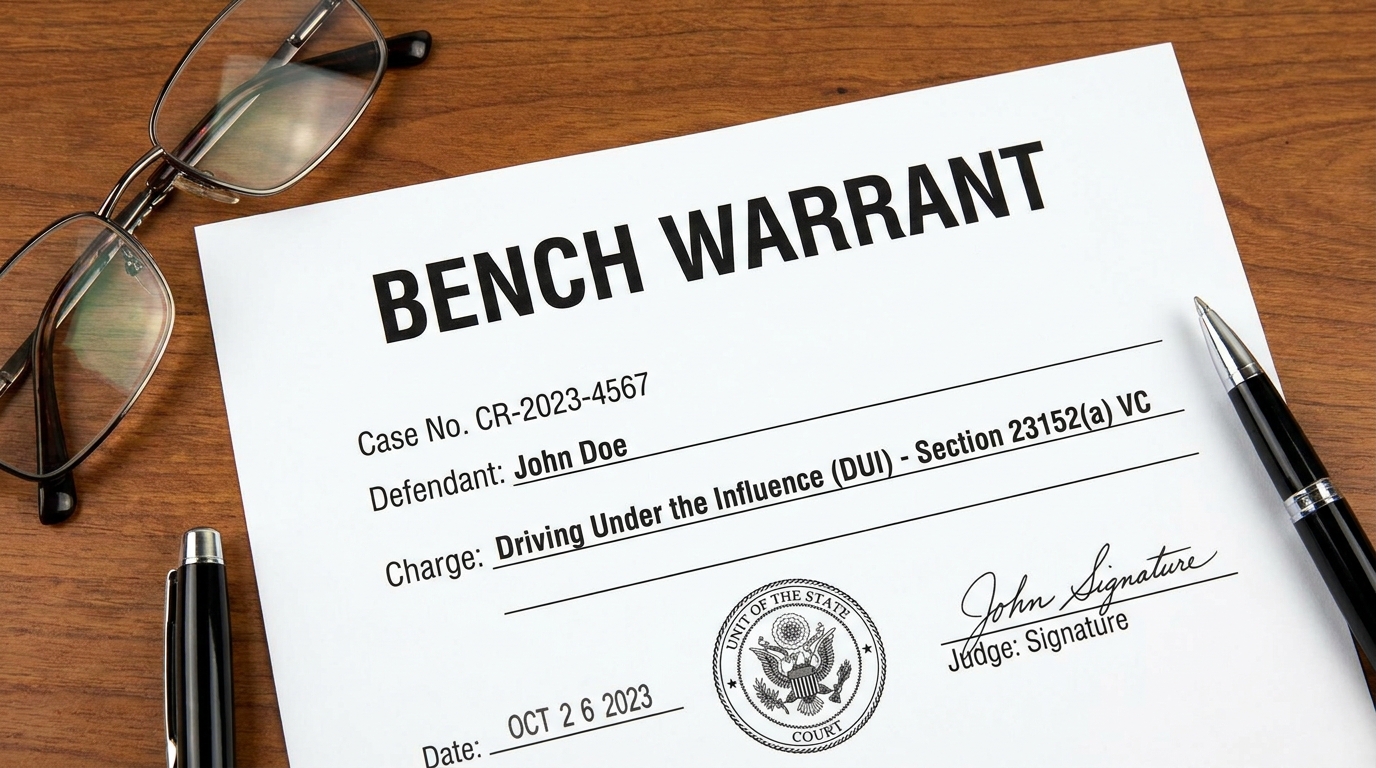
A bench warrant and a separate failure-to-appear charge are not necessarily the same thing. A judge may issue a warrant because a defendant missed court, but whether prosecutors can establish an additional criminal offense depends on the facts and the specific Arizona statute involved.
ARS 13-2506 addresses failure to appear in court connected with misdemeanor or petty offenses. The statute provides that a person can commit the offense when the person was required by law to appear in connection with a misdemeanor or petty offense and knowingly failed to appear as required. That form of the offense is a Class 1 misdemeanor. The same statute also addresses someone who gave a written promise to appear or was personally served with written notice under ARS 13-3903 and later failed to appear personally or through counsel. That form is classified as a Class 2 misdemeanor.
In plain English, forgetting a court date, receiving incorrect information, or never receiving proper notice raises different questions from knowingly deciding not to attend court despite knowing attendance was required. The word knowingly matters under ARS 13-2506(A)(1). A criminal defense lawyer can review the notice, minute entries, citation, communications with prior counsel, address records, and other evidence when determining whether the state can actually establish the required elements.
ARS 13-2507 applies when a person is required by law to appear in connection with a felony and knowingly fails to appear. A violation is a Class 5 felony. This can become particularly important in an aggravated DUI case or another felony criminal case pending in Arizona Superior Court.
Consider two examples. A driver charged with a misdemeanor DUI in Tempe accidentally writes the arraignment date on the wrong day and discovers the mistake after checking the online case record. That situation may require immediate action to address a warrant, but it is different from deliberately refusing to appear. By comparison, a defendant facing a felony aggravated DUI in Maricopa County Superior Court who knows about a mandatory hearing and intentionally does not attend could face much more serious exposure under ARS 13-2507.
When Does an Arizona Court Issue a Bench Warrant?
A bench warrant is an order issued by a judicial officer authorizing law enforcement to take a person into custody. Unlike an arrest warrant based on a new allegation of criminal conduct, a bench warrant often arises from something that happened within an existing criminal case, such as failing to appear for a scheduled court proceeding.
Arizona’s court system states that bench warrants are commonly issued when a defendant does not appear for court or does not comply with a court order. A judge, magistrate, commissioner, or justice of the peace can issue a warrant. Once issued, a police officer may arrest the individual.
The exact response to a missed court date can vary. The judge may consider which proceeding was missed, whether the defendant had notice, the defendant’s prior attendance history, whether an attorney appeared, whether the defendant contacted the court quickly, and whether there are concerns that the defendant will not return. Release conditions and bail or bond can also become an issue after an arrest on the warrant.
Do not assume that having an attorney automatically excuses a personal court appearance. Whether counsel may appear without the defendant depends on the type of hearing, the court’s order, and applicable procedure. ARS 13-2506(A)(2) does recognize an appearance personally or by counsel in the specific written-promise situation described by that provision, but that does not give every DUI defendant permission to skip every scheduled hearing.
How to Quash a Bench Warrant After Missing DUI Court
To quash a bench warrant means asking the court that issued it to cancel it. A prosecutor cannot simply erase the warrant for your arrest. The Arizona Judicial Branch states that a judicial officer from the jurisdiction where the warrant arose must quash or cancel it.
The process varies by court. Phoenix Municipal Court, for example, currently allows a person to submit a written motion to cancel a warrant. Its instructions tell the person to provide identifying information, explain why the court date or payment was missed, state what action the person wants the judge to take, and submit supporting documents when available. The judge may cancel the warrant and set a new court date, cancel it under other applicable conditions, or schedule a motion hearing to address the request.
For a criminal case in Maricopa County Superior Court, the court advises people with warrants to seek legal representation. The court notes that an attorney can confirm the facts surrounding the warrant and may be able to file a motion to quash it or otherwise resolve it. A warrant issued by Superior Court remains in effect until the issuing court resolves it.
A DUI attorney handling this situation may take several steps:
- Confirm which Arizona court issued the warrant and why.
- Review the docket and minute entries to identify the missed court appearance.
- Determine whether a separate failure to appear charge has been filed.
- Gather records explaining the absence, such as medical documents or proof of incorrect notice.
- File a motion asking the judge to quash the bench warrant.
- Request a new court date or warrant hearing when appropriate.
- Address any related driver’s license suspension, bond issue, or additional criminal charge.
A motion does not guarantee that a judge will quash a bench warrant issued in Arizona. The issuing judge controls that decision. This is one reason someone who discovers a bench warrant should contact a failure-to-appear lawyer immediately, rather than assuming the warrant will disappear with time.
Potential Penalties for Failure to Appear in a DUI Case
The potential penalties depend on why the defendant was required to appear and which subsection of Arizona law applies. Under ARS 13-2506(A)(1), knowingly failing to appear in connection with a misdemeanor or petty offense is a Class 1 misdemeanor. Under ARS 13-2506(A)(2), failing to appear after the written promise or personal notice described by that subsection is a Class 2 misdemeanor.
Arizona’s general misdemeanor sentencing law, ARS 13-707, permits up to six months in jail for a Class 1 misdemeanor and up to four months for a Class 2 misdemeanor. Under ARS 13-802, the maximum base fine for an individual is $2,500 for a Class 1 misdemeanor and $750 for a Class 2 misdemeanor, before applicable surcharges and assessments.
A felony-related failure to appear under ARS 13-2507 is a Class 5 felony. For a non-dangerous Class 5 felony when the person has no prior felony conviction, ARS 13-702 lists a prison sentencing range from six months at the mitigated level to 2.5 years at the aggravated level, with a presumptive term of 1.5 years. A felony fine for an individual may reach $150,000 under ARS 13-801. Actual sentencing depends on the case and whether incarceration, probation, mitigation, prior convictions, or other sentencing laws apply.
Prior felony convictions can materially increase prison exposure. ARS 13-703 creates enhanced sentencing ranges for repetitive felony offenders. For example, the Class 5 felony ranges increase for defendants qualifying as category two or category three repeat offenders. Whether a prior conviction legally qualifies as a historical prior felony requires a case-specific analysis.
Attorney Arja Shah can examine both sides of the problem: the alleged failure to appear and the underlying DUI case. The goal is not simply to address the warrant for your arrest. It is also to prevent an avoidable missed court date from distracting from valid challenges to the DUI charge itself.
The penalty ranges above are statutory possibilities, not predictions about a particular case. The Maricopa County Justice Courts also warn defendants receiving criminal traffic complaints that failure to appear can result in a driver’s license suspension, an additional misdemeanor failure-to-appear charge, and an arrest warrant.
Defense Strategies for Failure to Appear and the Underlying DUI Charge
A missed court appearance should not be treated as proof that the defendant intended to avoid court. It also does not prove the underlying Arizona DUI charge. Arja Shah can independently examine the court record, the events leading to the missed appearance, and the DUI evidence.
Several defense tactics may be relevant:
- Challenge whether the failure was knowing. ARS 13-2506(A)(1) and ARS 13-2507 require a knowing failure to appear. Evidence that the defendant did not have accurate notice, misunderstood a rescheduled hearing date, was hospitalized, or had another documented problem may be important when addressing that element.
- Review notice and court records. The defense can examine whether notice was mailed to the correct address, whether a scheduled court date was changed, whether the defendant was properly informed, and whether court records accurately reflect the required appearance.
- Present documentation explaining the absence. Hospital records, emergency records, travel disruptions, proof of incarceration elsewhere, communications with counsel, or documents showing incorrect notice can help explain why someone missed court.
- Seek prompt voluntary resolution of the warrant. An attorney may file a motion to quash the bench warrant and request a hearing rather than leaving the arrest warrant outstanding. Maricopa County Superior Court specifically identifies a motion to quash as one possible way an attorney may seek to resolve a warrant.
- Challenge the original DUI traffic stop. Even after a missed court date, the defense can examine whether police had sufficient legal grounds to stop the vehicle.
- Challenge BAC or chemical testing. Breath or blood testing may raise issues involving calibration, observation periods, collection procedures, blood storage, laboratory handling, chain of custody, or the interpretation of results.
- Challenge actual physical control. Some Arizona DUI cases involve a person found in or around a vehicle rather than observed driving. The facts surrounding actual physical control may become a major issue.
- Review constitutional violations and statements. Depending on the facts, the defense may challenge unlawfully obtained evidence, statements, searches, or other constitutional problems.
For example, assume a Mesa driver is arrested for DUI after being found asleep in a parked vehicle. The driver later misses a scheduled court appearance because notice went to an old address. The warrant problem and the DUI case involve separate legal questions. The defense may seek to quash the warrant while also arguing that the circumstances surrounding the vehicle do not establish the prosecution’s theory of actual physical control.
Shah Law Firm can treat both issues as parts of the same criminal case strategy. Getting the warrant resolved can help restore order to the case, while continued DUI defense can focus on whether the prosecution can prove impairment, BAC allegations, driving, actual physical control, or the legality of the investigation.
Common Reasons People Miss Arizona DUI Court Dates
People miss court dates for many reasons. Some knowingly ignore a court order, but many missed court dates occur because of mistakes, emergencies, or communication problems. That distinction can matter when Arizona law requires proof that the defendant knowingly failed to appear.
A defendant may have written down the wrong date, confused Phoenix Municipal Court with another Maricopa County court, moved and failed to receive mailed notice, misunderstood whether attendance was required, or believed that defense counsel would appear on the defendant’s behalf. Medical emergencies, hospitalization, transportation failures, work emergencies, family emergencies, and unexpected custody in another jurisdiction can also affect attendance.
Take a Scottsdale resident who has a DUI case scheduled in a Phoenix-area justice court. The hearing is moved from one date to another, but the defendant continues relying on the old calendar entry. When the mistake is discovered two days later, ignoring the situation can make matters worse. Promptly contacting a criminal defense attorney gives counsel a chance to check whether a bench warrant was issued and determine whether to file a motion.
Another common problem occurs when defendants assume a warrant stays outstanding only for a few weeks or months. Arizona courts state that arrest warrants remain active until the person is arrested or the issuing court addresses the warrant. Time alone does not cancel an arrest warrant.
FAQs About Missing a DUI Court Date in Arizona
What should I do if I just realized I missed my DUI court date?
Check the case promptly and contact a DUI or criminal defense attorney. The attorney can determine whether the court issued a bench warrant, whether a failure to appear charge was added, and whether your driver’s license is affected.
Do not assume that because only a few hours or days have passed, there is no warrant for your arrest. Court action can occur quickly, and the proper response depends on the issuing court.
Does missing court automatically mean I am charged with failure to appear?
No. A bench warrant being issued and being convicted of failure to appear are separate issues. The court can issue a bench warrant because you missed a required appearance, but a criminal failure-to-appear charge has statutory elements that the prosecution must establish.
For example, ARS 13-2506(A)(1) applies when a person required to appear in connection with a misdemeanor or petty offense knowingly fails to appear. ARS 13-2507 applies to a knowing failure involving a felony.
Can police arrest me at home or work for an Arizona bench warrant?
An active bench warrant authorizes law enforcement to arrest the person identified in the warrant. Arizona’s Judicial Branch states that a police officer may physically arrest a defendant once a bench warrant has been issued.
The fact that the underlying case involves a misdemeanor DUI does not mean the warrant should be ignored.
Does an Arizona bench warrant expire?
Generally, you should not expect an outstanding warrant to disappear simply because time passes. Arizona courts state that an arrest warrant remains effective until the person is arrested or appears before the court to address it, and the issuing court controls whether the warrant is canceled.
If an old warrant appears in your Arizona criminal case, a lawyer can determine which court issued it and what procedure is available to resolve it.
Can I fly if I have a bench warrant?
Travel plans do not cancel or suspend an Arizona warrant. An outstanding warrant continues to create a risk of arrest until the issuing court resolves it.
You should not assume that boarding a flight means the warrant is harmless or inactive. If you learn that a bench warrant has been issued, dealing with the issuing court before unnecessary law enforcement contact occurs is generally the safer legal approach.
Should I walk directly into court after learning about the warrant?
That depends on the court, the warrant, and the criminal case. Walking into court without checking the case may expose you to arrest or unexpected bond conditions. In other situations, voluntary appearance may be the proper way to resolve the warrant for your arrest.
A criminal defense lawyer can check the case, determine which court issued the warrant, and ask whether the court permits a written motion to quash, a warrant hearing, a scheduled appearance, or another procedure. Phoenix Municipal Court, for example, provides a written motion procedure for asking a judge to cancel a warrant.
Can my DUI attorney appear in court without me?
Sometimes counsel can handle particular proceedings without the defendant, but you should never assume your attorney’s attendance excuses your personal appearance. Whether you must appear in person depends on the type of hearing, the judge’s order, court rules, and the circumstances of the case.
If you are represented, ask your attorney whether you must appear in person for every scheduled court appearance. When a court has specifically ordered you to appear, follow that order unless the court changes it.
Important Things to Remember
- A missed DUI court date in Arizona can lead to a bench warrant.
- A bench warrant does not automatically mean you have been convicted of failure to appear in court.
- ARS 13-2506 addresses several misdemeanor-related failure-to-appear situations.
- ARS 13-2507 makes a knowing failure to appear in connection with a felony a Class 5 felony.
- Missing court after a criminal Title 28 complaint can result in a driver’s license suspension under ARS 28-3308.
- A warrant generally remains outstanding until the issuing court addresses it.
- The prosecutor cannot cancel a judicial warrant independently.
- A motion to quash asks the issuing judge to cancel the bench warrant.
- Medical emergencies, notice problems, incorrect dates, and other documented circumstances may matter when explaining a missed appearance.
- Missing court does not prove the underlying Arizona DUI allegation.
- DUI defenses involving the traffic stop, BAC testing, blood evidence, actual physical control, and constitutional violations may still be available.
- Acting quickly can give your attorney more options for addressing the warrant before an unexpected arrest.
How Shah Law Firm Can Help

A missed DUI court date can make it feel as though the entire case has suddenly gotten worse, but the warrant and the original DUI allegations need to be evaluated separately. Attorney Arja Shah can review the court docket, determine whether a bench warrant has been issued, identify whether an additional failure-to-appear charge exists, and evaluate the procedure for asking the court to quash the warrant. Arizona courts themselves recommend seeking legal representation when a criminal warrant is discovered.
Shah Law Firm can also continue fighting the underlying DUI charge. A failure to appear does not establish that the police conducted a lawful traffic stop, that chemical testing was reliable, that a BAC result was accurate, or that the state can establish driving or actual physical control beyond a reasonable doubt. Arja Shah can examine those issues while working to repair the court appearance problem.
Arja brings almost 20 years of law practice and more than 3,000 successful case victories to clients facing DUI and criminal charges in Arizona. Shah Law Firm’s experience with Arizona prosecutors, law enforcement agencies, plea negotiations, evidentiary disputes, and trial preparation can be especially valuable when a client is facing both an active DUI case and a bench warrant. The firm’s website reports representing more than 3,000 Arizona criminal defendants.
If you missed a DUI court date in Phoenix, Scottsdale, Tempe, Mesa, Chandler, Glendale, elsewhere in Maricopa County, or another Arizona jurisdiction, contact Shah Law Firm as soon as possible. Free one-on-one consultations with criminal defense attorney Arja Shah are available. Call (602) 560-7408 to request a confidential consultation. The firm’s current contact page confirms the free consultation and phone number.

