





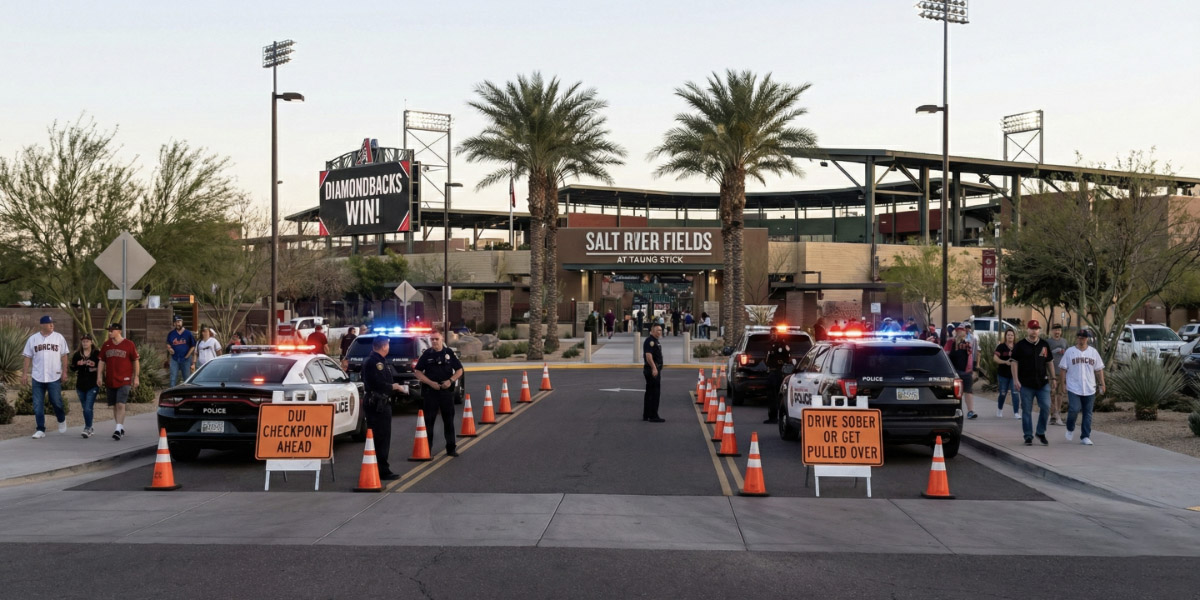
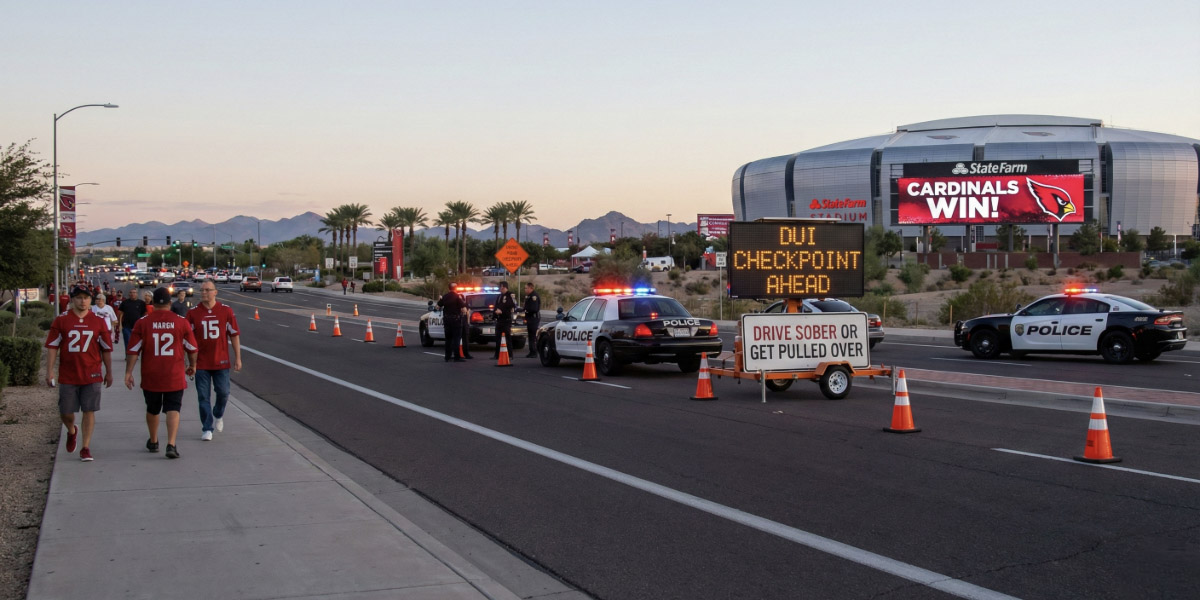
Major sporting events bring excitement to Glendale, Phoenix, Scottsdale, and Tempe. Cardinals games at State Farm Stadium, Suns games in downtown Phoenix, spring training in Scottsdale and Tempe, and college football bowl games draw thousands of fans. Along with packed stadiums and busy nightlife, law enforcement agencies increase patrols and set up DUI checkpoint locations to discourage drunk driving.
If you were stopped at a DUI checkpoint during a big event, you may be wondering whether the stop was legal and what your rights were. Many people are confused about how DUI checkpoints work and what they must do when asked to pull over. Arizona law allows sobriety checkpoint operations, but there are strict rules officers must follow.
This article explains how DUI checkpoints work in Arizona, your rights at DUI checkpoints, and what happens if you are charged with a DUI after a checkpoint stop. If you are facing a DUI charge after a checkpoint stop, experienced DUI defense attorney Arja Shah can review your case, identify legal issues, and help protect your rights.
Table of Contents
- Are DUI Checkpoints Legal in Arizona?
- How DUI Checkpoints Work During Major Sports Events
- What Are Your Rights at DUI Checkpoints?
- What Happens if You Are Asked to Perform a Field Sobriety Test or Take a Breathalyzer?
- Can Police Search Your Vehicle at a DUI Checkpoint?
- Defense Strategies After a DUI Arrest at a Checkpoint
- Frequently Asked Questions About DUI Checkpoints in Arizona
- Important Things to Remember
- How a Defense Attorney From Shah Law Firm Can Help
Are DUI Checkpoints Legal in Arizona?
Many drivers ask whether DUI checkpoints legal operations are allowed in this state. The short answer is yes: checkpoints are legal in Arizona. However, they must follow strict guidelines under Arizona law and constitutional protections.
The key case is State v. Superior Court (Simmons), a case that highlights the importance of proper procedures by law enforcement officers, 143 Ariz. 45 (1984). In that case, the Arizona Supreme Court held that a DUI checkpoint in Arizona is lawful if it meets specific standards designed to limit arbitrary enforcement. Officers cannot simply pull over drivers at random without supervision or a neutral plan.
Under this ruling, law enforcement officials must use a neutral formula for stopping vehicles, such as stopping every third or fifth car. Officers in the field cannot decide on their own which cars to stop. Supervisors must approve in advance the location, time, and procedures for checkpoints set up by law enforcement. This ensures that checkpoints set up by law enforcement operate consistently and constitutionally.
DUI checkpoints are often set up during major sporting events, such as New Year’s Eve celebrations, playoff games, or large festivals. Law enforcement agencies increase visibility to discourage drunk drivers and promote public safety. While the goal is to reduce driving under the influence, officers must still respect constitutional protections.
If officers fail to follow the required procedures, the stop may violate the Fourth Amendment. That can open the door for an experienced DUI defense attorney to challenge the legality of the stop in a court of law.
How DUI Checkpoints Work During Major Sports Events
During large sports events in Glendale, Phoenix, Scottsdale, and Tempe, checkpoints are often set near stadiums, entertainment districts, and major highways. For example, after a Cardinals game in Glendale or a spring training game in Scottsdale, traffic congestion provides an opportunity for law enforcement officers to conduct a sobriety checkpoint.
Here is how DUI checkpoints set up by law enforcement work in practice:
- Drivers approach a clearly marked roadblock.
- Officers briefly stop vehicles according to a predetermined pattern.
- The officer may ask the driver for a driver’s license, proof of insurance, and vehicle registration.
- The officer will check for signs of intoxication, such as slurred speech, bloodshot eyes, or the smell of alcohol.
The stop must be brief unless law enforcement officers develop a reasonable suspicion of criminal activity. If the officer observes signs of intoxication, the stop can expand into a DUI investigation. At that point, the officer may ask the driver to pull over to the side for further evaluation.
Under Arizona law, officers need reasonable suspicion to extend the stop beyond the initial checkpoint contact. If they believe they have probable cause that a DUI violation occurred under ARS 28-1381, law enforcement officers may make a DUI arrest.
The goal of these checkpoints is to discourage drunk driving, not to create random traffic stops. Law enforcement must follow structured procedures, and drivers retain important rights throughout the encounter.
What Are Your Rights at DUI Checkpoints?
Many drivers feel intimidated when stopped at a checkpoint. It is important to understand your rights and remain calm.
When stopped at a DUI checkpoint, you must provide your license and registration upon request. Arizona law requires drivers to carry a valid driver’s license and proof of insurance. You should also provide vehicle registration if asked.
However, you have the right to remain silent beyond providing identifying information. You are not required to answer any questions about where you were, how much you drank, or whether you consumed alcohol. You may politely refuse to answer those questions.
You also have the right to refuse to perform field sobriety tests, but it is advisable to consult a DUI attorney before making that decision. These tests may include walking in a straight line, standing on one leg, or following an object with your eyes. These exercises are voluntary. Politely refuse if you choose not to participate.
If officers ask you to take a breathalyzer test after you are arrested, Arizona’s implied consent law under ARS 28-1321 applies, and you may want to consult a DUI attorney. Under this law, refusal may also result in an automatic suspension of the license, which is why it’s important to consult a DUI attorney. This is separate from any criminal DUI case. It is important to know the difference between pre-arrest voluntary tests and post-arrest implied consent testing.
Drivers sometimes ask whether they can turn around to avoid a checkpoint. If you do so legally, without violating traffic laws, it may be allowed in the state of Arizona. However, making an illegal U-turn or other traffic violation can give officers reasonable suspicion to conduct a separate DUI stop.
Knowing your rights at DUI checkpoints helps you handle the situation calmly and avoid making statements that may be used against you later.
What Happens if You Are Asked to Perform a Field Sobriety Test or Take a Breathalyzer?
If an officer believes there are signs of intoxication, you may be asked to exit your vehicle and perform field sobriety tests. These tests often include walking in a straight line, balancing on one foot, or following instructions designed to evaluate coordination.
Field sobriety tests are subjective. Factors such as fatigue, medical conditions, or uneven pavement can affect performance. You may politely refuse to take a field sobriety test. There is no automatic license suspension for refusing roadside coordination tests.
If the officer believes there is probable cause, you may be arrested and asked to take a breathalyzer test. Under ARS 28-1321, Arizona’s implied consent law requires drivers to submit to testing after a lawful arrest. If you refuse, your license suspension can be longer than if you submit.
Breathalyzer devices must be properly calibrated and administered according to strict procedures. Problems with the breathalyzer test, including maintenance issues or operator error, can affect the results.
If you are facing a DUI charge after submitting to or refusing testing, an experienced DUI defense attorney can evaluate whether law enforcement must have had proper probable cause for the arrest and whether testing procedures complied with Arizona DUI laws.
Can Police Search Your Vehicle at a DUI Checkpoint?
Being stopped at a checkpoint does not automatically allow officers to search your vehicle. The Fourth Amendment protects against unreasonable searches.
Officers may search your vehicle if they have probable cause.
- You give consent.
- They have probable cause to believe evidence of a crime is inside.
- There are exigent circumstances.
You have the right to politely refuse consent to search your vehicle. Simply state that you do not consent. This preserves your rights and may help your defense lawyer challenge any unlawful search later.
Law enforcement officials must follow constitutional rules. If evidence was obtained improperly, a criminal defense attorney may file a motion to suppress that evidence.
Defense Strategies After a DUI Arrest at a Checkpoint
If you were arrested after a checkpoint stop, there may be several defense strategies available. Every DUI case is unique, and experienced criminal defense representation is critical.
Possible defense tactics include:
- Challenging the Legality of the DUI Checkpoint
If checkpoints must follow strict guidelines and officers deviate from the approved plan, the stop may be unconstitutional. - Lack of Reasonable Suspicion
If officers extended the stop without valid grounds to suspect intoxication, your rights may have been violated. - Lack of Probable Cause can be a strong defense when represented by a knowledgeable DUI attorney
If the arrest was not supported by sufficient evidence, your DUI arrest may be challenged. - Breathalyzer Accuracy Issues
Improper calibration, operator error, or maintenance failures can affect the reliability of breath tests. - Constitutional Violations
If law enforcement officials must advise you of your right to remain silent after arrest and fail to do so, statements may be suppressed.
Attorney Arja Shah has extensive experience in DUI defense and experienced criminal defense litigation. She examines whether checkpoints comply with constitutional standards and builds a strong defense to achieve the best possible outcome.
Frequently Asked Questions About DUI Checkpoints in Arizona
Can I refuse to stop at a DUI checkpoint?
No. If you are stopped at a checkpoint, you must comply with lawful instructions. Failing to stop may result in additional charges.
Are checkpoints announced in advance?
Often, law enforcement agencies publish general information on government websites or in the media to show transparency.
Do I have to answer any questions?
You must provide identification documents, but you may refuse to answer other questions.
Will I automatically lose my license if arrested?
Not automatically, but refusal to take a breathalyzer test can trigger administrative license suspension under ARS 28-1321.
Should I hire a DUI defense lawyer?
If you are charged with a DUI, seeking legal advice quickly can protect your rights and improve your chances of a favorable result.
Important Things to Remember
- DUI checkpoints are legal in Arizona if conducted properly
- Law enforcement officers must follow strict constitutional guidelines.
- You must provide identification documents
- You may politely refuse voluntary field sobriety tests
- Refusing post arrest testing can result in license suspension
- You have the right to remain silent
- A checkpoint stop can be challenged if procedures were not followed
How a Defense Attorney From Shah Law Firm Can Help

If you were stopped at a DUI checkpoint set up by law enforcement in Glendale, Phoenix, Scottsdale, or Tempe after a major sporting event and are now facing a DUI charge, you need experienced legal representation from a DUI attorney immediately.
Arja Shah is an experienced DUI defense attorney with nearly 20 years of practice and more than 3,000 successful case outcomes. She understands how DUI checkpoints work and can evaluate whether law enforcement complied with constitutional requirements.
Shah Law Firm provides personalized attention to every client. You are not just a case number. Arja Shah examines the checkpoint procedures, officer reports, body camera footage, and testing records to build a strong defense.
Call Shah Law Firm today at (602) 560-7408 to schedule your confidential case review. Protect your rights and take action now.

