





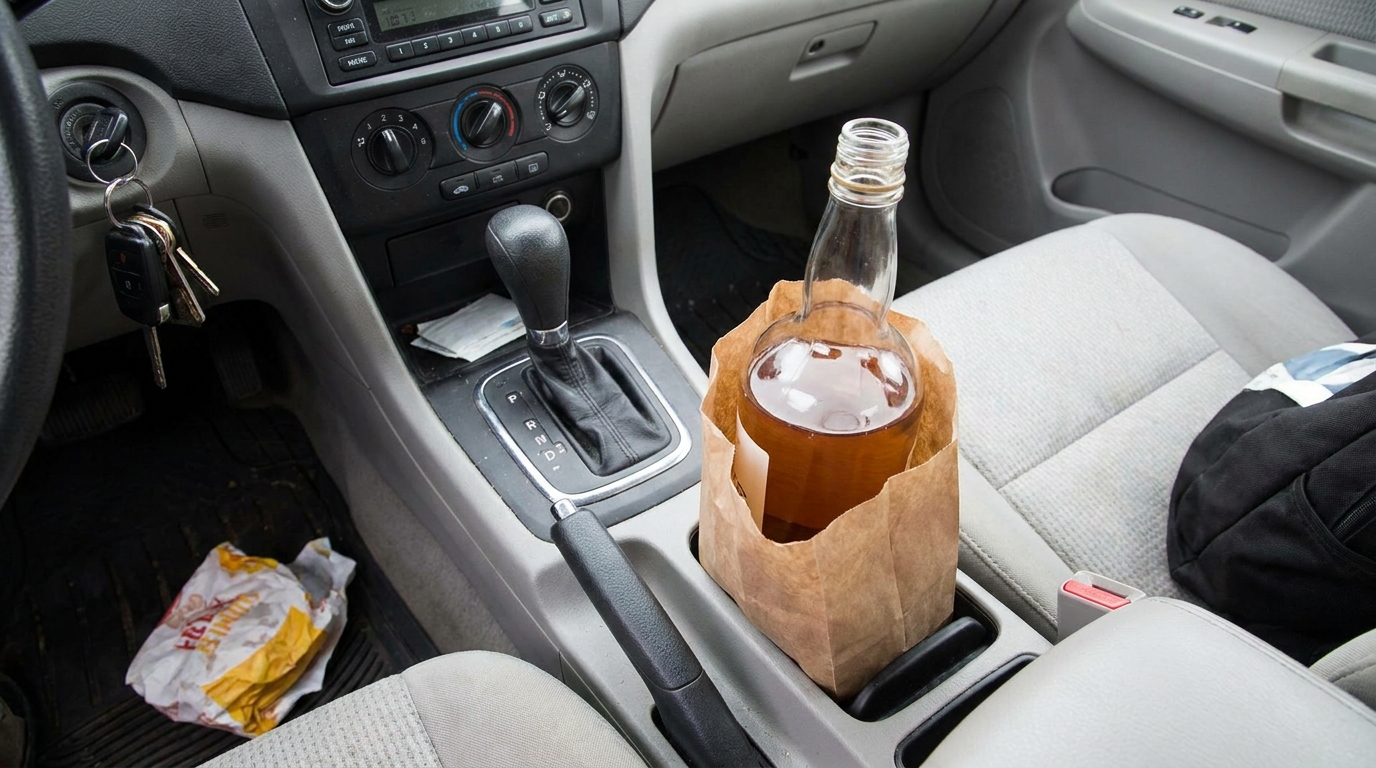
Arizona’s open container law can surprise people because it does not focus only on the driver. A passenger can also be charged if there is an open container of alcohol in the passenger area of a motor vehicle on a public road. The key statute is ARS 4-251, officially titled “Spirituous liquor in motor vehicles; prohibitions; violation; classification; exceptions; definitions.” In plain English, this state law makes it illegal for a person to drink alcohol or possess an open container of alcohol in the passenger compartment of a vehicle located on a public highway or the right-of-way of a public highway in Arizona.
This article matters because an open container violation often starts with a normal traffic stop. A law enforcement officer may stop a vehicle in Phoenix, Scottsdale, Tempe, Mesa, Chandler, Glendale, or another Arizona city, see a bottle or can in the passenger area, and then ask questions that can affect both the passenger and the driver. Even when nobody feels impaired, alcohol in the passenger area of a vehicle can lead to a criminal charge, court dates, fines, and added concern if the driver is also being investigated for DUI.
By reading this article, you will learn when Arizona’s open container law applies to passengers, what counts as an open alcoholic beverage container, where alcohol can be legally kept in a car, and which vehicles can legally have open containers in limited situations. You will also see how Shah Law Firm and attorney Arja Shah can help if a simple ride home turns into an open container charge, a DUI investigation, or a broader criminal case.
Table of Contents
- Does Arizona’s Open Container Law Apply to Passengers?
- What Counts as an Open Container of Alcohol in Arizona?
- Passenger Area Rules, Public Highways, and Where Alcohol May Be Kept
- Exceptions to Arizona’s Open Container Law
- Penalties for an Open Container Violation in Arizona
- How an Open Container Case Can Affect a DUI or Criminal Case
- Defense Strategies Used to Fight an Open Container Charge
- FAQs About Arizona Open Container Laws
- Important Things to Remember
- How Shah Law Firm Can Help
Does Arizona’s Open Container Law Apply to Passengers?
Yes. Arizona’s open container law applies to both the driver and passengers in many common situations. ARS 4-251(A)(1) prohibits a person from consuming spirituous liquor while operating or while within the passenger compartment of a motor vehicle located on a public highway or public highway right-of-way. ARS 4-251(A)(2) also prohibits a person from possessing an open container of spirituous liquor within the passenger compartment of that motor vehicle, reinforcing the penalties for violating open container laws. The wording “any person” is why a passenger can be charged, not only the person behind the wheel.
The law applies regardless of whether the vehicle is moving at the exact moment an officer sees the alcohol. The statute focuses on whether the motor vehicle is located on a public highway or the right-of-way of a public highway in this state. That can include a vehicle stopped at a red light, pulled over on the shoulder, or parked along a road that is generally open to public vehicle travel. The phrase “whether the vehicle is moving” matters because many people think the law applies only while the car is being driven, but ARS 4-251 is broader than that.
For example, say a group leaves a restaurant in Old Town Scottsdale. The driver is sober, but a passenger gets into the back seat with an open beer. If the car is on a public road and the open alcohol is in the passenger area, the passenger may face an open container violation even if the driver has not been drinking. If the officer suspects the driver is impaired, the open beer may also become part of a DUI investigation under ARS 28-1381, which prohibits driving or being in actual physical control while impaired to the slightest degree or with an alcohol concentration of 0.08 or more within two hours of driving.
A second example is a passenger in Tempe holding a plastic cup with a mixed drink while a friend drives away from a party. Even if the cup is not a bottle or can, it may still count as an open container if it is a receptacle that contains spirituous liquor and has been opened or partially consumed. Arizona law does not require the state to prove the passenger was driving. The state must prove the parts of the open container charge, including the open alcohol, the passenger compartment, and the public highway or right-of-way connection.
What Counts as an Open Container of Alcohol in Arizona?
ARS 4-251 defines an “open container” as a bottle, can, jar, certain dispensed containers, or another receptacle that contains spirituous liquor and has been opened, has had its seal broken, or has had some of its contents removed. In plain English, an open bottle, open can, half-empty flask, unsealed growler, or cup containing alcohol can create a problem if it is in the passenger area of a motor vehicle on a public road.
An unopened container is different. A sealed six-pack in a grocery bag, a bottle of wine with the original seal intact, or a closed liquor bottle that has not been opened is not normally the type of open alcoholic beverage container covered by this specific definition. Problems arise when the seal is broken, the cap is off, the cork has been removed, the pull tab is open, or the contents have been partially removed. A container can still be considered open even if no one is actively drinking from it when the officer walks up.
The statute uses the phrase “spirituous liquor,” which is common in Arizona alcohol laws. In daily speech, that can mean beer, wine, liquor, mixed drinks, and other alcoholic beverages. The label on the container is not the only issue. A law enforcement officer may consider the smell, the container, the liquid inside, body camera footage, statements from people in the car, receipts, and the container’s location in the vehicle.
This is one reason legal representation can matter even in a seemingly minor case. A prosecutor still has to prove the charge. If the container was empty, the liquid was not alcohol, the seal was not broken, or the item was not in the passenger compartment, the defense may have room to challenge the charge. Attorney Arja Shah can review the police report, officer notes, body camera video, and any photographs to see whether the evidence actually matches the statute.
Passenger Area Rules, Public Highways, and Where Alcohol May Be Kept
The passenger area of a motor vehicle is one of the most important parts of ARS 4-251. The statute defines “passenger compartment” as the area designed for seating the driver and other passengers. It also includes an unlocked glove compartment and unlocked portable devices within the immediate reach of the driver or passengers. That means an open container in a center console, door pocket, cup holder, back seat, floorboard, unlocked glove box, purse, backpack, or cooler may create legal risk if it is within reach in the passenger area.
The same definition also tells you where open alcohol may be stored more safely during transport. The passenger compartment does not include the trunk, a locked glove compartment, or the area behind the last upright seat of a motor vehicle that does not have a trunk, which is critical in understanding open container laws in Arizona. In plain English, if you need to transport open containers of alcohol, such as an unfinished bottle from a private event, the safer place is usually the trunk. In an SUV or hatchback without a trunk, the area behind the last upright seat may fall outside the passenger compartment under the statute.
The law also requires the vehicle to be located on a public highway or the right-of-way of a public highway. ARS 4-251 defines that phrase to include the full width between and immediately next to the boundary lines of a way maintained by the federal government, Arizona, or a county, city, or town, if any part of it is generally open to public vehicle travel. In plain English, public roads, shoulders, and nearby right-of-way areas can count.
These details matter in real cases. A passenger in Mesa may think that placing an open bottle under the seat avoids the law, but the area under a passenger seat is still part of the passenger area. A driver in Chandler may think an open bottle in the unlocked glove box is safe, but ARS 4-251 specifically includes an unlocked glove compartment as part of the passenger compartment. Small details like a locked glove compartment, a trunk, or the vehicle’s exact location can make a major difference in the defense.
Exceptions to Arizona’s Open Container Law
Arizona’s open container law has specific exceptions. ARS 4-251(C) says the statute does not apply to a passenger in a bus, limousine, taxi, or transportation network company vehicle while that vehicle is being used to provide transportation network services. The statute also does not apply to a passenger in the living quarters of a motor home, which is an important exception to the open container regulations. These exceptions are narrow but important for people using hired transportation or traveling in an RV.
For a rideshare or transportation network company vehicle, the vehicle must be used to provide transportation network services. That detail matters. Sitting in a friend’s personal car is not the same as being a passenger in a covered-for-hire ride. A limousine used for a booked event is also different from a regular private car, especially in terms of exceptions to the open container regulations. The exception turns on the type of vehicle and the way it is being used at that time.
The motor home exception is also limited. It applies to a passenger in the living quarters of a motor home, not to every seat or area in every RV-related vehicle. A person sitting in the living quarters while someone else lawfully drives may be treated differently from a person sitting in the front passenger seat with an open container. The exact design of the vehicle and the passenger’s location can matter.
A useful example is a bachelorette party in downtown Phoenix. If the group is in a licensed limousine and passengers have open alcohol in the passenger section, ARS 4-251 may not apply because of the limousine exception. But if the same group leaves the limo, gets into a private car, and someone keeps drinking from an open bottle while the vehicle travels on a public road, that private-car situation can result in an open-container charge. The facts control the outcome.
Penalties for an Open Container Violation in Arizona
A violation of ARS 4-251(A) is a class 2 misdemeanor. ARS 13-707, officially titled “Misdemeanors; sentencing,” sets the maximum jail term for a class 2 misdemeanor at four months. ARS 13-802, officially titled “Fines for misdemeanors,” sets the maximum fine for a class 2 misdemeanor at $750. In plain English, an open container charge is not, by default, just a warning or a minor traffic ticket. It is a criminal misdemeanor that can create a record if it ends in a conviction.
The exact penalty depends on the court, the facts, the person’s prior record, the prosecutor’s position, and the defense presented. Some cases may be resolved without jail, while others can involve probation, alcohol education, fines, assessments, or other court orders. If the open container stop also leads to a DUI allegation, the stakes rise sharply because Arizona DUI law carries its own mandatory jail, fines, alcohol screening, traffic survival school, and ignition interlock rules in many cases. ARS 28-1381 classifies regular DUI as a class 1 misdemeanor and lists required penalties for a conviction.
Repeat-offense issues can also matter. ARS 13-707(B) says a person who is at least eighteen, or who has been tried as an adult, and is convicted of the same misdemeanor or petty offense within the prior two years may be sentenced for the next higher class of offense, with some limits and conditions in the statute. That is one reason a person should not assume an open container case is harmless just because the facts seem simple.
Shah Law Firm often looks for ways to reduce the long-term harm of a misdemeanor alcohol charge. Attorney Arja Shah may examine whether the state can prove possession, whether the vehicle was on a public road, whether an exception applies, whether the stop or search violated constitutional rights, and whether the case can be dismissed, reduced, or resolved in a way that protects the client’s record.
| Issue or Charge | Relevant Arizona Statute | Classification | Possible Penalty | Plain-English Notes |
| Consuming alcohol while operating or while in the passenger compartment | ARS 4-251(A)(1) | Class 2 misdemeanor under ARS 4-251(B) | Up to 4 months in jail under ARS 13-707(A)(2), and up to a $750 fine under ARS 13-802(B) | Can apply to a driver or passenger in the passenger area of a motor vehicle on a public highway or right-of-way. |
| Possessing an open container in the passenger area | ARS 4-251(A)(2) | Class 2 misdemeanor under ARS 4-251(B) | Up to 4 months in jail under ARS 13-707(A)(2), and up to a $750 fine under ARS 13-802(B) | An open bottle, can, cup, jar, or similar container may qualify if it contains alcohol and has been opened or partially consumed. |
| Repeat misdemeanor concern | ARS 13-707(B) | May be sentenced at the next higher class if the statute applies | Potentially higher jail and fine exposure, depending on the record and court findings | Prior misdemeanor history should be reviewed before any plea is entered. |
| Related DUI charge if the driver is accused of impairment | ARS 28-1381 | Class 1 misdemeanor for regular DUI | Mandatory DUI penalties may include jail, fines, screening, traffic survival school, and ignition interlock when liquor is involved | An open container is not the same as DUI, but it can become evidence in a DUI investigation. |
How an Open Container Case Can Affect a DUI or Criminal Case
An open container violation and a DUI charge are distinct, but they often arise during the same traffic stop. For a DUI, the state may focus on driving behavior, odor of alcohol, statements, field sobriety tests, blood or breath results, and whether the person was impaired to the slightest degree. ARS 28-1381 covers several DUI theories, including impairment by alcohol, drugs, or a combination, an alcohol concentration of 0.08 or more within two hours of driving, certain drug metabolite cases, and lower alcohol concentration thresholds for commercial drivers and drivers for hire.
An open container in the passenger area may prompt police to ask more questions. Officers may ask who owns the container, who drank from it, when it was opened, where the group came from, and whether the driver consumed alcohol. Passengers may think they are helping by answering casually, but statements can sometimes hurt the driver or the passenger. If the stop becomes a DUI investigation, the open alcohol can become one piece of the state’s story.
Still, an open container does not prove DUI on its own. A sober driver can have a passenger with an open beer. A passenger can possess alcohol without the driver knowing, but this could lead to potential issues with violating open container laws. A bottle may have been in the vehicle from an earlier event. The state must prove each charge separately. For DUI, the state must prove the driver was driving or in actual physical control and met one of the DUI standards in ARS 28-1381. For an open container, the state must prove the container, location, public road, and possession or consumption elements under ARS 4-251.
A DUI-related stop can also lead to charges involving underage drinking. ARS 4-244 prohibits a person under the legal drinking age from buying, receiving, possessing, or consuming spirituous liquor, subject to exceptions stated in the statute. It also prohibits a person under twenty-one from driving or being in physical control of a motor vehicle while there is any spirituous liquor in that person’s body. These rules may apply when the passenger or driver is under 21.

Defense Strategies Used to Fight an Open Container Charge
A strong defense starts by breaking the charge into parts. The state may have to prove that the item was an open container, that it contained alcohol, that it was in the passenger compartment, that the vehicle was on a public highway or right-of-way, and that the accused person possessed it or consumed from it. Attorney Arja Shah and Shah Law Firm can test each part instead of treating the police report as the final word.
Common defense tactics include:
- The container was not in the passenger area. ARS 4-251 excludes the trunk, a locked glove compartment, and the area behind the last upright seat in a vehicle without a trunk from the passenger compartment. If alcohol were stored in one of those places, the charge may not fit the statute.
- The container was not open. A sealed bottle, unbroken package, or unopened container is not the same as a container with a broken seal or partially removed contents. Photographs, body camera footage, and the officer’s own description may be important.
- The liquid was not proven to be alcohol. A cup, bottle, or can may look suspicious, but suspicion is not proof. The defense can ask whether the liquid was tested, whether the officer relied only on smell, and whether there are innocent explanations.
- The vehicle was not on a covered public highway or right-of-way. ARS 4-251 applies to a motor vehicle located on a public highway or right-of-way. A charge may be weaker if the vehicle was on private property that is not generally open to public vehicle travel, though each location must be reviewed carefully.
- An exception applied. Passengers in a bus, limousine, taxi, covered transportation network company vehicle, or the living quarters of a motor home may fall outside ARS 4-251. If the facts show one of these exceptions, the defense can raise that issue early.
- The accused person did not possess the container. In a car with several people, it is not always clear who had control over a bottle or can. The state may need more than “it was nearby.” Seat location, fingerprints, statements, video, and witness accounts can matter in determining whether there was an illegal to have an open container in the vehicle.
- The stop, search, or seizure was unlawful. If an officer lacked a legal basis for the stop, expanded the stop without proper grounds, or searched areas of the vehicle in violation of constitutional protections, a defense attorney may seek to suppress evidence.
- Statements were taken in violation of Miranda. Police do not have to read Miranda warnings during every roadside conversation. But if a person is in custody and is questioned without required warnings, certain statements may be excluded from evidence.
These defenses are fact-specific. A person should avoid assuming the charge will disappear because “it was only the passenger’s drink” or because the car was not moving. The better approach is to preserve evidence quickly, write down what happened, save receipts or rideshare records if an exception may apply, and speak with a defense attorney before making statements in court.
Shah Law Firm can also look beyond the legal theory. Arja Shah may consider the client’s record, immigration concerns, professional licensing concerns, employment issues, school obligations, and whether the prosecutor may agree to dismissal, diversion-style terms, reduced charges, or another result that limits damage. Even a small misdemeanor can have an outsized effect when it appears on a background check.
FAQs About Arizona Open Container Laws
Can a passenger drink alcohol in a moving vehicle in Arizona?
Usually, no. A passenger may not consume alcohol in the passenger compartment of a motor vehicle located on a public highway or the right-of-way of a public highway unless a statutory exception applies. Exceptions include certain passengers in a bus, limousine, taxi, or transportation network company vehicle used for covered services, or in the living quarters of a motor home.
Can the driver be charged if the passenger has an open container?
Yes, it is possible, but the facts matter. If the open container is in the passenger area and the state claims the driver possessed it or allowed it nearby, the driver may face scrutiny. Even if the passenger is the only person charged with an open container, the driver may still face a DUI investigation if the officer suspects impairment.
Is an open container violation the same as DUI?
No. Open container and DUI are separate charges. An open container charge focuses on alcohol in the passenger compartment of a motor vehicle on a public road or right-of-way. DUI under ARS 28-1381 focuses on driving or actual physical control while impaired, having an alcohol concentration of 0.08 or more within two hours of driving, or meeting another DUI theory listed in the statute.
Can I legally transport an open bottle of alcohol after a party?
You may be able to transport it if it is kept outside the passenger compartment. ARS 4-251 says the passenger compartment does not include the trunk, a locked glove compartment, or the area behind the last upright seat in a motor vehicle without a trunk, in accordance with the Arizona revised statutes. Keeping alcohol away from the driver and passengers is the safer choice.
What if the open bottle belonged to someone else in the car?
Ownership is not always the same as possession. The state may look at who held it, where it was found, who made statements about it, and who had access to it. A passenger should not plead guilty without checking whether the state can prove that the passenger actually possessed an open container.
Can a passenger be charged in a parked car?
Yes, depending on where the car is parked. ARS 4-251 applies when the motor vehicle is located on a public highway or the right-of-way of a public highway. A parked car on a public street or shoulder can still create risk. A private driveway or private property location may raise different issues.
Should I hire an attorney for an open container charge?
It is smart to at least speak with a criminal defense attorney. A class 2 misdemeanor can carry jail exposure, fines, and a criminal record. Shah Law Firm offers free one-on-one lawyer consultations, and attorney Arja Shah can explain the risks, defenses, and likely court process based on the facts of your case. Call (602) 560-7408 to contact the office.
Important Things to Remember
- Arizona’s open container law applies to drivers and passengers in many private vehicle situations.
- ARS 4-251 prohibits consuming alcohol or possessing an open container in the passenger compartment of a motor vehicle on a public highway or public highway right-of-way.
- An open container can include a bottle, can, jar, cup, or other receptacle that contains alcohol and has been opened, has a broken seal, or has had contents removed.
- The passenger area includes seating areas, an unlocked glove compartment, and unlocked portable items within reach of the driver or passengers.
- The passenger area does not include the trunk, a locked glove compartment, or the area behind the last upright seat in a vehicle without a trunk.
- Passengers in a bus, limousine, taxi, covered transportation network company vehicle, or living quarters of a motor home may fall within specific exceptions.
- A violation is a class 2 misdemeanor, with possible jail time and a fine.
- An open container charge is not the same as DUI, but it can become part of a DUI investigation.
- Do not assume the police report tells the whole story. The details of the stop, search, container, vehicle, and passenger location can change the defense.
How Shah Law Firm Can Help

If you were charged with an open container violation in Phoenix, Scottsdale, Tempe, Mesa, Chandler, Glendale, or another Arizona city, Shah Law Firm can help you understand the next steps. A misdemeanor alcohol charge may seem minor compared with a DUI, but it still deserves careful attention. Attorney Arja Shah can review what happened, explain the court process, and look for defenses that may reduce or eliminate the charge.
Shah Law Firm offers free one-on-one lawyer consultations for people facing DUI and criminal charges. The firm’s website highlights attorney Arja Shah’s almost 20 years of criminal defense experience, over 3,000 successful victories, and a focus on DUI and criminal defense in Phoenix and the surrounding areas. That experience matters when a case involves local prosecutors, local court policies, police reports, body camera footage, and plea negotiations.
Arja Shah’s trial skills and negotiation strengths can be valuable in open container and DUI-related cases. Some cases should be pushed toward dismissal because the evidence is weak. Others may benefit from a negotiated result that avoids the worst penalties. Shah Law Firm’s strong relationships with Arizona prosecutors and law enforcement can help the defense team clearly discuss the facts, identify weaknesses in the state’s case, and seek the best possible result.
You do not have to handle the charge alone. Call Shah Law Firm at (602) 560-7408 to request a free consultation. A conversation with attorney Arja Shah can help you protect your rights, your record, and your future.

